Malaysia Today blog was hit by a hacker a week or so ago and is belived that the Malaysian government view the blog as a real threat to their injustice and twisted policies, even warranting the special operation to shut the blog down.
-------------------------------------------------------------------------
Malaysia's Future Is Still A Dream
Malaysian politics is still plagued by racial and religious sentiments and true equality for all racial groups is still a dream, said Raja Petra Kamarudin. When can we achieve a society without the distinction of races and religions? Raja Petra pessimistically said that even in the era of our grandchildren, Malaysia's politics might not be completely rid of racial politics. Raja Petra said Malaysia has gone through 50 years of Merdeka. He could not predict how it would go for the next 50 years. But he stressed that as long as no changes are done to the education system, the situation would be the same or even worse. “Racial harmony requires a very long time to be achieved but it can be destroyed within a second. The 13 May incident is an example,” he said.He bluntly said that the goal of no racial politics could not be achieved with the presence of Umno, MCA and MIC. “In fact, not only Umno or the Malays can't run away from racial politics, but MCA and MIC as well,” he added. He pointed out that during the general elections, Malays voted for Chinese and Indians voted for Malays. But after the elections, the major parties distributed official positions according to the quota system instead of according to the ability of the candidates.
To Fight Injustice
Raja Petra Kamarudin told Guang Ming Daily that Datuk Seri Anwar Ibrahim nearly died in the lock-up when he was arrested in 1998. It aroused his indignation and therefore he decided to return to the political arena and thereafter launched the Free Anwar Campaign. “Politics is politics. Perhaps Anwar should be punished, but not under the allegations of sodomy. He shouldn't be assaulted, or worse, almost killed,” said Raja Petra. He said that according to the medical report he had seen, Anwar suffered a near fatal injury. “The only reason Anwar was not killed was because former Federal Commercial Crimes Investigation Director Datuk Ramli Yusoff managed to stop former Inspector-General of Police Abdul Rahim Noor,” he said. He initially worked for PKR when it was formed in 1999 but chose to launch the Free Anwar Campaign outside the party in 2000, as he wanted the whole world to know about the Anwar issue. “It was not only about Anwar but also about what was happening in our country's political arena. Anwar was an issue but it was not the only issue,” he said. On 11 April 2001, Raja Petra, together with nine opposition party members, was detained for 52 days under the Internal Security Act. On 13 August 2004, he set up the website called Malaysia Today. Two weeks later, on 2 September 2004, Anwar was released from jail. He stressed that he is a full-time website editor. He chose not to directly participate in politics as he wanted to be free to criticise injustice with impartially. He said: “Regardless if it is the ruling party or the opposition, once you do something wrong I'll criticise you.“When you are the ruling party you will point your fingers at the opposition and when you are the opposition you will point your fingers at the ruling party. There is no direction. This is politics. But I can criticise anyone as an outsider,” he said. Raja Petra firmly believes that everyone has the right to speak. Thus, his website Malaysia Today serves as a channel for everyone to express their views and opinions.
Najib Changes The Ending For Team A And Team B
In 1987, Datuk Seri Anwar Ibrahim wanted to contest for the Umno Vice President position. The then Umno had been split into Team A and Team B – Tun Dr Mahathir Mohamad's camp and Tengku Razaleigh Hamzah's camp. Anwar was the Umno Youth Chief and Datuk Seri Najib Tun Razak was his deputy. Raja Petra said that both Dr Mahathir and Anwar realised that if Najib swung to Tengku Razaleigh then Team B would have a higher chance of winning. He said that most of the Chinese did not identify with Tun Abdul Razak but he was greatly supported by Malays. Thus, his son Najib managed to gain support as well. “Najib wished to be the Umno Youth Chief. He could make it as long as Anwar stayed out of the way. Thus, Anwar said Najib could be the Umno Youth Chief with a condition that he supported Dr Mahathir,” he said. Raja Petra believed that Najib was not a fighter. He would not aggressively fight for any position. However, he would accept the position if it was ‘offered’ to him. “It is true even until today.”“Najib expressed his support for Dr Mahathir at the very last minute. Otherwise, Tengku Razaleigh might have become the Prime Minister instead and Malaysia's history would have turned out very different,” he added. During the most critical period of the Team A and Team B tussle, Raja Petra and Anwar discussed the situation together with Kamaruddin Jaafar. He revealed that: “At that time, we heard that Tengku Razaleigh's chances of winning was very high. We analysed it and I told Anwar that the votes from the Umno Youth members were very important. That's why Team B led by Tengku Razaleigh was trying its best to swing Najib to their side. We asked Anwar's opinion as to which side he would take.”“Anwar rejected Team B. He said he had promised Dr Mahathir his support. He also threatened to resign if Tengku Razaleigh won and Dr Mahathir lost.”Dr Mahathir, in turn, said he would not resign even if he won only by one vote. Eventually, Dr Mahathir won with a majority of only 40 or so votes.
Abdullah Is A Political Master
To Raja Petra Kamarudin, Prime Minister Datuk Seri Abdullah Ahmad Badawi is a political master. He can face up to political heavyweights like Datuk Seri Anwar Ibrahim and Deputy Prime Minister Datuk Seri Najib Tun Razak. After Umno's internal struggle between Team A and Team B, the Registrar of Societies declared the party unlawful. Mahathir then formed the new Umno and excluded the members from Team B, included the party's elder statesmen like Tunku Abdul Rahman and Tun Hussein Onn. Raja Petra revealed that the then party elder statesmen registered a new party with the name “Umno Malaysia” while Dr Mahathir registered his “Umno Baru” three days after he got to know about it. Later, Tengku Razaleigh Hamzah's camp was informed that the name “Umno Malaysia” was not approved as someone else had applied to use the same name.“Razaleigh had no choice but to form “Semangat 46”. However, the crafty Abdullah, who was also in Team B, did not join Semangat 46. Eventually, Abdullah returned to Umno,” he added. Raja Petra said if Abdullah had joined Semangat 46, he would not be where he is today.
“I Believe Anwar Is Innocent
"I strongly believe that Anwar is innocent,” said Raja Petra Kamarudin. Why does he believe that Anwar is innocent and that Deputy Prime Minister Datuk Seri Najib Tun Razak is involved in the Altantuya murder case? Raja Petra said without hesitation: “Who personally saw Anwar sodomise anyone? And Najib should clear his name in court to prove his innocence, with evidence.” Raja Petra also claimed that he still has information regarding the Altantuya murder case and in time he will reveal more. When asked from where he got his information, he did not deny that he had many sources, which included members of the royal family as well as senior Umno members. When he was asked why he believes Anwar is innocent, he asked: “Do you know the truth? If you think he is guilty, then show me the evidence and prove it.” He refused to comment on Anwar's 16 September regime change plan and replied, “Anything can happen in politics.” To him, any information about Anwar's plan was confidential. “I have my sources and I believe in the information that I got from them. But this is not the time to show the public,” he added.
Anwar Should Not Have Challenged Tun Ghafar Baba
When talking about his former comrade-in-arms PKR Adviser Datuk Seri Anwar Ibrahim, Raja Petra Kamarudin said it was not about “personal loyalty” but both of them persisted in their own principles. Raja Petra met Anwar at the Malay College Kuala Kangsar. Anwar was his senior as he was three years older than him. Later, when Anwar formed the Malaysian Islamic Youth Movement (ABIM), Raja Petra supported him. He said that he and Anwar have been friends with a same goal but with different routes. Later, Anwar joined Umno but Raja Petra did not agree with this move and did not follow him into Umno. Two or three years later, Anwar wanted to challenge Suhaimi Kamaruddin for the Umno Youth Chief position. Anwar asked for help from his old friends and Raja Petra agreed to help. However, he stressed, “I supported Anwar but not Umno.” Raja Petra helped campaign for Anwar including organising dinners and setting up network connections during the campaign period. Eventually, Anwar won. Raja Petra continued to help Anwar as an outsider when he contested the Umno Youth Chief position three times in a row. Then he said: “That's enough!”Anwar's power within Umno was strengthened after he became the Umno Youth Chief. But he was too ambitious and wanted to challenge Tun Ghafar Baba for the position of Deputy Umno President. Raja Petra and many of Anwar’s friends did not agree with Anwar challenging Ghafar as they felt he should wait until the Deputy President retires. “We all knew that Ghafar would not become the Prime Minister. He was nine months older than Dr Mahathir and his education background was only standard six. But Malays respected him, as he was one of the fighters for the independence of Malaya.” “Malays have deep respect for Ghafar. You don't just overthrow him like that. Anwar should have given Ghafar more time to resign on his own. Therefore, I didn't agree with the young Anwar challenging Ghafar. I think he was showing no respect to an elder.” Thus, Raja Petra and Anwar parted ways. He and his friends no longer wanted to help Anwar in his campaign for Deputy President.“However, Anwar had strong support from Umno Sabah. At that time there was a bonus system in which a candidate would automatically receive 10 bonus votes for every nomination. The situation was very unfavourable to Ghafar so he stepped down to allow Anwar to take over.”
Mahathir Destroys Anwar
Datuk Seri Anwar Ibrahim changed after he became the Deputy Prime Minister cum Finance Minister. Umno changed him, said Raja Petra Kamarudin. He became just another “Umno man”.“He wore RM3,000 suits, unlike the time when we wore traditional Malay costumes. Before he joined the party he said he wanted to change Umno but instead he was the one who was changed by Umno,” Raja Petra said. Thereafter, Raja Petra did get involved with Anwar any longer but instead became active in PAS. He wrote for the English Section of PAS' Harakah and in some of his pieces he even criticised Anwar. Anwar was really angry at that time. When Anwar was sacked in 1998, he told Anwar that: “You deserve it! You can challenge Ghafar Baba, but not Mahathir.” Raja Petra said that Anwar thought after easily overthrowing Tun Ghafar Baba he could easily depose Tun Dr Mahathir Mohamad as well. Eventually, he failed and Dr Mahathir did him in instead.
I Have More Inside Stories To Tell
“I believe in what I believe. Send me to jail. I’m not afraid,” he said about his latest brush with the law. In his most sensational disclosure to date, Raja Petra posted on his blog a bombshell entitled Let's Send The Altantuya Murderers To Hell. This was the closest anyone has ever dared link Deputy Prime Minister Najib Razak and his wife, Rosmah Mansor, to the murder of the Mongolian beauty under mysterious circumstances. This immediately brought tremendous pressure on Najib. RPK, as he is more fondly known, was quickly arrested and detained for three days and charged under the Sedition Act on 5 May. But he hit back: “It's worth it. Send me into jail! I'm not afraid of it.”He says he’s not interested in money and does not work for money’s sake. All he pursues in his lifetime is “freedom and democracy”, and he does what he considers “the right things to do”. “My life is simple. I don't need much money. I'm not fighting for personal gains. What I believe in is my belief,” he said. He says Malaysians are forgetful and are also afraid of changes. Raja Petra said: “Malaysians are always afraid of this and that. Why should we be scared of our own shadows?” He believes in fate and in trusting everything to God, thus it would not be necessary to worry too much. Raja Petra, 58, has no need to worry about money since he was a child. He is both liberal and bohemian at the same time. He advocated anti-war sentiments and the fight for democracy since his teenage years. The Vietnam War in the 1960s and 1970s was the beginning of his struggle. The hippie culture arose during the Vietnam War period. The then teenager Raja Petra liked to travel around the country on his motorbike. He took to the Flower Power of the 1960s to carry out social reforms tempered with love and peace. Different people impacted him at different stages of his life, including Cuban revolutionary Che Guevara, member of the famous band Beatles, John Lennon, and Iran's highest leader Khomeini, Ayatollah Ruhollah. Raja Petra even participated in Iran's reform movement and anti-Saudi Arabian movements in the fight for a reformation of Islamic culture and once even joined pro-Iranian demonstrations in Mekah, Saudi Arabia. But he is not a Muslim extremist. He has his own principles, hoping to see modern Islamic beliefs emerging someday. On his relationship with PKR adviser Datuk Seri Anwar Ibrahim, and his writing articles inclined to the Opposition, he said: “I'm not helping him, I just do what I should do.”


 Slabs of tombstone leaning against the wall of the ruin of St. Paul church


 The locals practising their ballroom dance steps in the community centre. Visitors are feel free to join. The atmosphere is fun, very opened and welcoming.

 Ok, Ok. We all know that the water of the Strait of Melaka ain't clear but polluted.


 One cannot claim he / she has been to Melaka without having the Nyonya kuih (dessert). So many variety to choose and to eat... Yum Yum


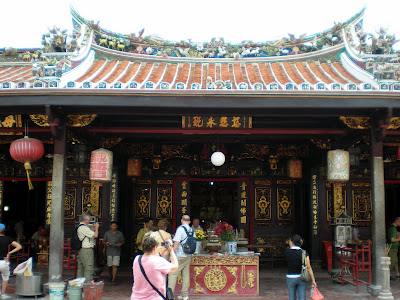


 View from inside the temple towards outside